Union Budget 2026: Powering India’s Green Energy Revolution
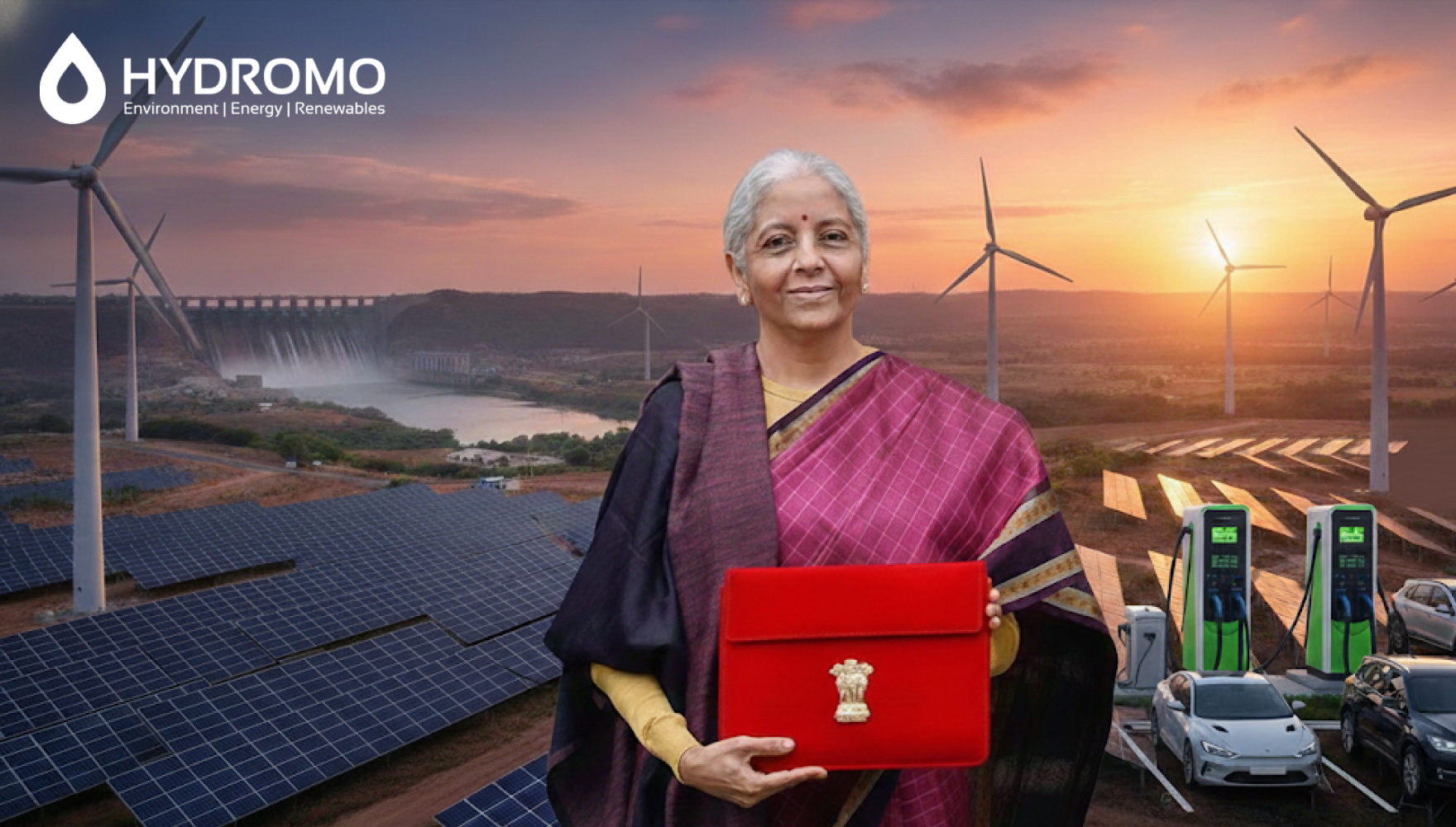
The Union Budget 2026- 27, which Finance Minister Nirmala Sitharaman tabled on February 1, 2026, has struck a judicious balance between economic growth and financial restraint, in line with the Viksit Bharat vision. Though it does not redesign the tax policy, it highlights that India is concerned with achieving sustainable growth by promoting renewable energy, developing essential infrastructure, and encouraging the use of clean technology.
The budget prepares a rapid green energy economy expansion – strengthening efforts of India to move to cleaner power, strong grids and more in-country manufacturing in energy value chains.
Renewables in the Middle of Growth.
There is also a high policy push in boosting the expenditure on renewable energy on the budget, which indicates strong motivation to hasten the production of power that is climate-friendly. The budget allocation of the Ministry of New and Renewable Energy (MNRE) increases to approximately 32,915 crore in FY 2026-27, which is an almost 30 per cent year-on-year growth.
Significant emphasis has been on increasing the rooftop solar by schemes such as the Pradhan Mantri Surya Ghar: Muft Bijli Yojana that has been allocated increased funds of 22,000 crore. This growth is an indication of ongoing government focus on the use of rooftop solar by households and commercial systems.
The budget supports solar energy as a pillar of the clean power policy of India by strengthening funding on renewables.
Boosting Solar Manufacturing and Supply Chains
To support “Make in India” plans on clean energy components, the budget has a number of duties-related incentives to grow domestic production:
Customs tax breaks on certain capital equipment in the production of lithium-ion cells and solar glass, which would aid in lowering the production cost and establishing localised supply chains. The further changes in the duty regime promote the manufacture of solar equipment and other essential inputs within the country instead of mostly depending on imports.
Such steps make solar panel and battery manufacturers more competitive and stimulate investment in the high-tech clean energy production.
Grid-Modernisation and Energy Storage.
A stable power system and energy storage are crucial in order to increase renewables. The budget also extends duty waivers on equipment to be used in Battery Energy Storage Systems (BESS) and Lithium-ion manufacturing, a move that is very important with reference to grid-scale storage and smooth integration between intermittent renewable generation.
Power grid enhancement is also useful to absorb increased solar and wind energy, increase energy security, and enable the emergence of electric cars and other new clean technologies.
Clean Mobility Electric Vehicle (EV) Infrastructure.
Although the 2026-27 budget has not declared a wave of new EV subsidies, it renewed supportive policies to develop the EV ecosystem:
Long term duty exemption on important components such as battery parts and important minerals to lower the cost of production and installation of EV charging facilities.
These measures can be used to reduce the cost of establishing EV charging networks and enable vehicle electrification indirectly by providing incentives to supply chains.
Incentives to Hard-to-Abate Sectors.
Other areas that are more difficult to decarbonize are also given a nod in the budget. It brings in strategic support of technologies such as Carbon Capture, Utilization and Storage (CCUS) with a multi-year expenditure.
This is the way to assist industries like steel, cement, and chemicals to use cleaner methods of production – to convert sustainability objectives into economic potential.


Comments
Post a Comment